Thursday, 4 October 2012

Nikon J1 and V1

All Resources Taken From NEWS

Nikon J1 and V1 - Review

nikonj1v1.jpg
With Olympus, Sony and Panasonic having introduced their mirrorless cameras long ago, everyone wondered, when, and even if, the big two, Canon and Nikon would enter the space. After much speculation, Nikon has finally broken the silence with the V1 and J1, two mirrorless interchangeable lens cameras that are part of the new Nikon 1 system.

Not adhering to the tradition micro four thirds standard, Nikon has chosen to develop their own 1-inch sensor dubbed the CX, which has also called for a redesign of not jus the lenses, but also the lens mount. We grab both the cameras and put them through their paces to see whether they live up to the hype that comes from being a flagship Nikon Product.

Note: Units reviewed here are the Black Nikon 1 V1 that came bundled with the 10mm f/2.8 pancake lens and a White Nikon V1 J1 that came bundled with the 10-30mm f/3.5-5.6 and the 30-110mm f/3.8-5.6 lenses. Both the lenses that came with the J1 also sport Nikon's proprietary Vibration Reduction technology. Since the cameras are identical, aside from a few key differences that we will note as we go along, we decided to do a joint review.
In the box
Camera (Nikon 1 V1 or Nikon 1 J1)
Camera Strap (Black for the V1, White for J1, unless you bought a J1 of a different color)
Paperwork (User manuals, warranty papers)
Battery (EN-EL15 for the V1 and EN-EL20 for the J1)
Battery Charger
Lenses (depending on what kit you purchase)
Build
The first thing we notice when we pull both the cameras out of their boxes is how similar they look to point-and-shoot cameras, especially the J1. Respecting the hierarchy of classification, the J1 is visibly thinner and smaller than its big brother, the V1.

The body of the J1 is constructed out of high grade plastic, but at the end of the day, it is still plastic. We wonder if it would survive an accidental five-foot drop - tempted, as we were to try, we couldn't since we had to return the review unit to Nikon. On the flip side, the guts and glory of the V1 are housed in a sturdy all-metal body that is not glossy, but matte. We feel a Leica influence here for sure.
Ergonomics
The V1 is bigger and thicker which means it can fit a bigger battery than the J1. Not that we're complaining, because, well, nothing there's nothing worse than running out of juice during an important shoot.

There is a minimal amount of buttons on both the cameras, with the Power, Shutter and a dedicated Video button being placed on top of the camera. The back features a small dial that allows switching between the limited shooting modes. There is a secondary dial that controls camera specific features along with a quartet of buttons.

nikonj1v1-2.jpg


An interesting addition to the controls is the horizontal bar at the top right corner of the back panel. On the V1, it serves as a means to change the aperture or shutter speed. On the J1, it only serves as a means to zoom into the photograph while in preview mode. In our experience with the V1, this horizontal bar seemed rather counter intuitive for changing aperture or shutter speed values, as up till today, all cameras have utilized the spinning dial at the back to register changes to these settings. We often ended up spinning the back dial when wanting to change the aperture values, only to realize that we were fiddling with the wrong controller. This is something that will take a little getting used to.

The V1 also enjoys the addition of a 1440K Dot TFT LCD viewfinder (also known as an electronic viewfinder), a feature that visibly sets the V1 and J1 apart, as the latter does not have a viewfinder. The view automatically switches from the back LCD to the viewfinder thanks to a sensor placed next to the viewfinder.
Features
The feature set on both cameras is the same as you would expect from any high end point-and-shoot. One interesting point of difference is the Dual Shutter present in the V1. While both the V1 and J1 sport an electronic shutter that can shoot exposures with values ranging from 30 seconds to 1/16000th of a second, the V1 also comes with a mechanical shutter.

The two shutters serve very different purposes, bringing with them their own unique advantages and drawbacks. The mechanical shutter allows the flash-sync-speed to reach up to 1/250th of a second, but reduces the overall fastest shutter speed possible to 1/4000th of a second. The mechanical shutter also creates a sound every time it fires. The electronic shutter brings the flash sync speed down to a painful 1/60th of a second, but offers silent shooting, boosts the fastest shutter speed to 1/16000th of a second (yes, that is a BLAZING ONE-SIXTEEN-THOUSANDTH OF A SECOND!) and the ability to shoot 10 frames per second.

There is more shutter magic to be enjoyed on the Nikon 1 system and it comes in the form of crazy fast burst shooting modes. When the shutter is switched to Electronic (Hi), the V1 can shoot at 10,30 or 60 frames per second. However, there is a catch. Since the photos cannot be written to the memory card as fast as the are being shot, actual number of frames captures is about 34 frames when shooting at 10 fps and 30 frames when shooting at 30 and 60 fps.

For the J1, the frames captured are 13 frames at 10 fps and 12 frames at 30 and 60 fps. One drawback of being able to shoot so many frames in such short spans of time is that when the data has to be written to the memory cards, it takes quite a while and during the time, the camera might lock up due to unavailability of space. Regardless, nothing can tarnish the joy that comes from shooting at such mind numbing speeds.

An interesting difference between the two cameras is that the J1 sports a built in flash that pops up at the push of a button (and must be manually pushed back into the closed position). The V1 lacks an on-board flash. Instead, it gains an accessory port that can be used to attach an external flash unit or an external mic for video recording.

nikonj1v1-3.jpg

Focus System
One of the most impressive feature sets of the Nikon 1 system is its contrast/phase detect focusing system. Conventional cameras (including DSLRs) use one or the other focusing mechanisms, but Nikon has managed to merge the two together, resulting in a system that is blazing fast to acquire focus, even in very low light.

Besides being quick to focus, the system can be tuned into one of three configurations; Single Point (with a total of 135 points to select from), Auto-Area (41 points to select from) and Subject tracking mode to track moving objects. We must mention here that the Nikon 1 system has the most focus points so far in a mirrorless interchangeable lens camera system and they all work very effectively.
Lens System
Now we generally have never spoken about lenses in a review, but the mirrorless cameras are changing that up since these cameras aren't much without a lens. Currently, there are only four lenses available for the Nikon 1 system:

10mm f/2.8 pancake lens (pancake because these lenses are very thin)
10-110mm f/4.5-5.6 PD-Zoom
10-30mm f/3.5-5.6 VR
30-110mm f/3.8-5.6 VR

We got to test out all the above lenses, except for the 10-110mm super zoom. In our use, we found that before the lenses could be used, they had to be unlocked by pushing a button followed by turning them to the right. This caused the lenses to protrude about an inch to the front, which we found extremely worrisome. This design does not work well in the event there are any accidental bumps to the camera while walking around. The only way to avoid the accidental damage would be to lock the lens after every use, which is quite cumbersome in itself.

Another rather surprising omission on the lenses was a manual focus ring. For a camera system that aims at being more SLR-like, why would Nikon choose to omit such a defining feature?

Just to be clear, the lack of a focusing ring on the lenses does not mean that manual focus is not available on the camera. We found that switching the camera's focus mode to manual and the spinning the dial at the back allowed us to focus manually. This is another cumbersome feature that defines both the V1 and J1 more in the same family as point-and-shoots rather than DSLR replacements.
Imaging
Like we mentioned earlier, Nikon has developed a proprietary 10 megapixel sensor for the 1 system and dubbed it the CX format. The sensor measures 1-inch in diagonal, placing it comfortably halfway between the point-and-shoot and Four Thirds format. The sensor has a conversion factor or 2.7, meaning that a lens advertised as 10mm would actually yield a viewable area of10x2.7 = 27mm and so on.

To be fair, shooting with the Nikon 1 system (both the V1 and J1) was quite enjoyable. Of course that was the case once we stopped bothering about switching into any mode other than auto, as the process of doing so requires going into the menu system and tinkering with the settings. The cameras do feature a dial that allowed us to switch between stills, Smart Photo Selector, Motion Snapshot and Video modes, but Manual, Aperture Priority and Shutter Priority options are omitted from this dial.

One drawback of having a small sensor is that in general, image quality takes a hit because the per-pixel size gets greatly reduced. With respect to that, the CX format sensor performs exceptionally well, delivering images with great clarity, well saturated colors and a rather pleasing level of contrast. Being able to shoot in RAW was a relief as by now we're wondering if there are any SLR like features in the two cameras.

One area where the sensor fails to perform is with regards to depth of field. Unfortunately, the small size of the sensor results in a larger-than-expected depth of field. This was apparent when we used the 10mm f/2.8 pancake lens and shot an object at f/2.8. There was background blur, but not as much as we would have seen from a similar lens shooting at the same aperture on a DSLR.
Video
The V1 and J1 both feature a dedicated video button next to the shutter button on top, however, video recording at full HD was only possible if the mode dial on the back was on Video. We're not even sure why there is a dedicated video button if we still need to switch over to the video mode before we can shoot. This is not to say that video cannot be recording when in Still Shot mode. The only problem with video while in Single Still mode is that the resolution of the video recorded is an unconventional 1072x720 at 60 frames per second and no, we did not have any control over this. The video recording size is also limited to 4GB.

The frustrations of design clearly flow into hampering the video recording experience. There is, however, a silver lining of sorts. While recording full HD video, we were able to shoot stills as well (albeit they were only 9 megapixel stills, without affecting the video recording in any way.
Verdict
We're having a hard time grasping what Nikon was aiming at achieving with the Nikon 1 system. Venturing into a realm that is looking at being a DSLR alternative while managing a compact size, Nikon got the 'compact' part somewhat right, but fell way short on the 'DSLR' part.

The lack of dedicated buttons to access quick features such as shooting modes (despite a physical dial being present!), inability to shoot video spontaneously despite a dedicated video button and not to mention, a complete lack of focus ring on the lenses makes the Nikon 1 system more like a glorified point-and-shoot rather than a DSLR competitor.

In favor of the Nikon 1 system, the bigger sensor does deliver some amazing looking images, along with offering a blazing fast auto-focus system. The V1 supports an accessory port, but accessories are currently limited to just an external flash and mic.


Pros
Image quality
Excellent focus system
Cons
Complicated to use
Price
Rating
Performance: 3.5
Features: 3
Ease of use: 2.5
Ergonomics: 3.5
Wow Factor: 3.5
Value for Money: 2
Overall: 3

Akai's new Smart Box

All Resources Taken From NEWS

Akai launches Android-based Smart Box for Rs. 6,590

AKAI_Android_SmartBox.jpg
Japanese consumer electronics firm Akai launched a 'Smart Box', which allows users to surf Internet on their television sets, at a price of Rs. 6,590 in the country.The company, which is targeting revenues of Rs. 250 crore this fiscal, expects sales of one lakh devices in the next 3-4 months.
"Our Smart box is set to change the way people watch television in India. TVs, irrespective of whether it's a colour TV or LCDs and LEDs, are compatible with the device and using Smart Box can be converted into a smart television," says Pranay Dhabhai, Akai's Managing Director.
The Android-based device, powered by a 1.25-Ghz processor, comes with a wireless mouse for navigation. It is equipped with 4GB internal memory, expandable upto 32GB through SD card slot.
Similar to Apple TV, Smart Box is a digital media device which allows users to access content like videos, games and websites using WiFi and broadband connection.
Google, which operates the Android platform, also plans to launch its set-top box 'Google TV'.
The Smart Box has 4 USB ports, hard drives as well as connect to Internet using 3G dongle.
The device connects to the internet using LAN, WiFi as well as 3G. It also acts as a router using which other devices like tablet PCs and laptops can be connected to Internet.
"In this fiscal, we are looking at a revenue of Rs. 250 crore, of which 20 percent we see coming from Smart Box. We see the device as a major revenue driver for us," Dhabhai said.
Last year, Akai India's revenues stood at Rs. 175 crore.
There are similar devices available in the Indian market.In June this year, Amkette had launched its 'EvoTV' priced at Rs. 9,995.
Akai India will sell the devices through ecommerce stores, its website as well large format stores and distribution channels. It will also launch television commercials and digital campaigns for the device.
"Right now, 80 percent of our revenues came from TVs, while the remaining 20 per cent from other consumer durables. Going ahead, we expect this to change to 75 percent (TVs) and 15 percent each from Smart Boxes and consumer durables," he said.

Xbox Music

All Resources Taken from NEWS

Microsoft to launch Xbox Music on Oct 26, alongside Windows 8

xbox-music-new.jpg
Xbox Music was initially announced by Microsoft at E3 this year. Now sources of The Verge familiar with Microsoft's plans suggest that the software giant has finally set a date for its official release. The company plans to launch the service on October 26, which is also the scheduled date for the company's much awaited latest OS, Windows 8.

Xbox Music is expected to offer ad-supported free music streaming on any device that uses a Microsoft-built OS including Windows 8 PCs and tablets, Windows Phone and of course, the Xbox 360.

Similar to Spotify, which is based on the same freemium model, users will be able to pay a monthly fee to enjoy the service without the ads along with subscriptions like the Zune Music Pass. But those who don't mind listening to a few ads after a couple of songs, do not need to pay a subscription fee.

Microsoft had launched SkyDrive, its cloud-based service a few months ago, which has now become a valuable asset in Windows 8. Well, Xbox Music will include SkyDrive integration that will allow users to store and access music and playlists in the cloud across all Windows 8 devices.

The Verge has also learnt that eventually, Microsoft plans Xbox Music to be available on cross platforms including iOS and Android as well, although apps for the two ecosystems won't be immediately available.

Furthermore, an Xbox Dashboard update will incorporate Xbox Music onto Microsoft's flagship gaming console. Music and video apps for Windows 8 will also be updated to support Xbox Music after launch. There are still no official dates for these changes but they're all likely occur on or around the 26th of this month.

Microsoft now has plenty on its plate with a new operating system an improved mobile platform and also a bunch of new devices hitting the market soon. The music service was the only thing left and lets hope that Microsoft makes the most of it on October 26 2012.

Nokia Xpress app

All Resources Taken From NEWS
Nokia launches Nokia Xpress Beta app for Lumia phones

nokia-xpress-browser-lumia.jpg
Nokia isn't stopping with its soon to be available Lumia 920 and Lumia 820 high-end smartphones. The Finnish handset maker has been experimenting with the Nokia browser for its S40 range of devices that compresses data before it reaches your device, thereby cutting down on data consumption.

This technology is now coming to all of Nokia's Windows Phone Lumia devices and it is called the Nokia Xpress. That said, for now, it will come with a beta tag.

Nokia Xpress is a cloud technology that powers a lot of Asha devices currently in addition to all the previous S40 devices. Xpress for Lumia works with Nokia Xpress on the cloud and delivers a fast and an efficient experience by minimising the data consumed, in turn saving some battery power for you to get through the day.

Nokia's Beta Labs blog mentions greater details of the app's capabilities. For starters, it features a magazine mode that lets you view web-based content in a neat magazine layout. You can also tap on any word in an article and get a contextual search instantly on Bing, YouTube or WikiPedia.
 
Xpress for Lumia also has a one-click language translation feature that can instantly translate your web page to the desired language of your choice, which is a great addition for travellers to help them get local information on the web.

The app also allows you to store any page you have visited for a later read in offline mode. A feature called QuickLinks, automatically adds tiles for your frequently visited sites on the QuickLinks screen and orders them based on frequency of visit.

Another interesting feature is the ability to download videos and other web content directly to SkyDrive, without consuming extra data. The videos can then be downloaded on to any device with SkyDrive.

One may consider this as a niche app. Those with monthly data plans of 2-5GB won't find it of mush use. But certain markets that offer premium data rates or if you're on international roaming, this app is definitely worth it.

FIFA 13


FIFA 13 sells over 4.5 million copies in five days

fifa13-cover.jpg
US videogame titan Electronic Arts on Wednesday announced that "FIFA Soccer 13" scored a sports title launch record by selling more than 4.5 million copies in the five days after its release.The newest edition of the annual EA Sports franchise had the hottest videogame debut overall this year and was a top-seller in at least 40 countries, according to the Northern California-based company.
The realistic soccer videogame proved especially popular in Britain, where more than 1.23 million copies were bought in the 48 hours after its release on September 25, EA reported.
"FIFA Soccer 13 is a critical and commercial success unprecedented in sports entertainment," said EA Sports executive vice president Andrew Wilson.
"Every minute of every day millions of fans around the world are experiencing what the critics have already said 'FIFA Soccer' 13 is the biggest and best sports game we have ever created."
More than 66 million online multi-player sessions of the game have been played, with the number of fans playing with or against one another on the Internet topping 800,000 on Saturday.

'Band Hero' videogame

All Resources Taken From NEWS

No Doubt settles lawsuit over 'Band Hero' videogame

Games-No-Doubt-635.jpg
No Doubt has settled its lawsuit against gaming giant Activision over the use of band members' likenesses in the video game "Band Hero," court records state.The settlement was reached Monday, a few weeks before trial was set to begin on the band's claims of fraud, violation of publicity rights, and breach of contract.
Terms of the settlement were not disclosed.
The band's attorney, Bert Deixler, declined comment. Michael Zeller, an attorney for Activision, did not immediately return a phone message.
The band sued Activision Publishing Inc. over a feature in the game that allows players to perform the songs of other artists using the likenesses of No Doubt front woman Gwen Stefani and other band members.
Activision had denied all wrongdoing and argued the idea of "unlocking" unadvertised features of a video game has been around since the early days of the industry.
The game debuted in November 2009 and was a spinoff of Activision's popular "Guitar Hero" game series.
No Doubt's lawsuit was filed after the release of "Band Hero" and claimed it turned the group into a "virtual karaoke circus act."
The case cited instances in which players could use Stefani's avatar to perform suggestive lyrics from the Rolling Stones' hit "Honky Tonk Women," or have a virtual version of bassist Tony Kanal sing his band's hit "Just a Girl" in Stefani's voice.

Apple narrows Samsung mobile gap; iPhone 5 to give further boost

All Resources Taken From NEWS

Apple narrows Samsung mobile gap; iPhone 5 to give further boost

apple-samsung-patent-battle.jpg
Apple narrowed the gap with Samsung smartphones in the precious US market in the months before the release of the hot-selling iPhone 5 model, industry tracker comScore reported on Tuesday.

Meanwhile, Apple and Android-powered smartphones continued to dominate the US market, where both platforms increased shares evidently at the expense of BlackBerry handsets made by Canada-based Research In Motion.

Samsung remained the top smartphone in the United States with an unchanged 25.7 percent of the market at the end of August while Apple's portion grew to 17.1 percent as compared to 15 percent in May, according to comScore.

Motorola and LG both lost just shy of a percent of market share to finish August with 11.2 percent and 18.2 percent of the US market respectively.

The number of smartphone owners in the United States grew six percent to 116.5 million in the three-month period that ended with the start of September.

Google-backed Android software remained the most popular smartphone platform with its share of the market growing 1.7 percent to 52.6 percent. Apple's bite grew 2.4 percent to 34.3 percent, according to comScore.

Apple's portion of the US market is expected to get even bigger given the record-breaking pace of sales of the latest-generation iPhone 5 model released last month.

Apple and Android gains in the quarter came at the expense of BlackBerry handsets made by Canada-based Research In Motion and smartphones powered by Microsoft or Symbian software, according to comScore figures.

RIM's share of the US market slid 3.1 percent to 8.3 percent while Microsoft and Symbian shed .4 percent each to drop to 3.6 and .7 percent respectively.

Wednesday, 3 October 2012

Review: Google Plus thoughtful answer to Facebook

All Resources Taken from NEWS

Review: Google Plus thoughtful answer to Facebook

circles1.jpg
My first thought about Google Plus: "Here we go again." After Google's earlier attempts at social networking failed spectacularly, it was easy to scoff at this seeming Facebook wannabe.

Its "Picasa ultimatum" didn't help much either. If you have an account with Picasa, Google's photo-sharing service, the first thing Google asks is whether you'd want to share your Picasa photos. Say no, and you're not allowed to sign up at all. That seemed unnecessarily harsh.

But I quickly became addicted to Google Plus, a free service that the company is testing with a small group of users for now. It has smart and thoughtful solutions to some irksome limits entrenched in other social-media sites, mainly related to privacy settings and how to share links and posts with groups.

Google Plus seems aimed at people who are more interested in sharing things with people or groups with similar interests rather than simply amassing the biggest number of online "friends." Its seamless integration with other Google services you may use, from search to online documents, makes it easier to share things online.

I found privacy settings much easier to manage on Google Plus than on Facebook. The Picasa ultimatum forced me to learn about the settings. After all, the first thing you're likely to do after joining is limit who can see your photos.

Privacy - deciding whom you share different posts with - seems to be top of mind on Google Plus. That's a relief after Google's earlier debacle with Google Buzz, which had arrived unsolicited and initially created circles of friends automatically based on whom
they've corresponded with on Gmail. That meant your boss could see lists of people you've been corresponding with for a new job.
With Google Plus, no one gets added automatically. Once you sign up, you add people - similar to how you follow people on Twitter.
Then, rather than throwing everyone into the same bucket, you choose a circle to put them in.

Four circles are standard: "friends," "family," "acquaintances" and "following." You can follow anyone without being accepted, whereas Facebook requires the consent of both sides.

You can create new circles, too, such as "co-workers" and "cousins." Facebook has customizable groups, as well, but I found the groups on Google Plus much easier to use and quicker to navigate.

Separating people into categories can seem awkward at first. I felt impolite putting people in "acquaintances" rather than "friends" even though no one can see which circle you put them in. But once you get used to it, you can easily share photos of your beach vacation with just your friends - your actual friends, not the broad Facebook definition. Those photos could be off-limits to your boss or your great aunt Zelda, say.

Any post or link goes only to the circle or circles you designate, and you can drill down to sharing with just one or two people, or no one. You can also make a link public to share it with everyone - including people who have added you to their circles but whom you haven't added to yours.

However, the privacy settings aren't perfect. Although you can choose to share a post with a limited number of people, the recipients can re-share the post further. It takes some digging to figure out that you can disable re-sharing by clicking on an icon to the right of a post. Google Plus is in very early testing, so these types of settings could still change.

Unlike Facebook, Google Plus also lets you edit posts after you post them and decide for each post whether to allow comments, a feature I liked.

Two other features, the ability to group video chat via webcam, called a "Hangout," and the ability to chat with a group, called a "Huddle," have proven to have so much appeal that Facebook quickly followed suit. The company said Wednesday that it will also roll out group chatting and video chatting by teaming with Internet phone company Skype. It will be interesting to see if Facebook ends up adding other Google Plus features.

Other facts: Google Plus has a "+1" button rather than a "Like" button, but the feature is similar. The only difference is, once you sign up for Google Plus, you see this "+1" button next to every single Google search item, which feels a bit Big Brother-ish.

On that note, whenever you are on the main Google site or any of its progeny, you also have a black Google bar across the top of your browser, with a Google Plus link. That makes it easy to log on at odd moments. A red notification box alerts you to Google Plus activities, such as when people add you to one of their circles.

Google Plus has a few gaping holes.

For example, you can't search ... yet. And there are no addictive third-party apps such as "FarmVille," which people have sunk countless hours playing on Facebook.

Another thing you can't do easily, strangely, is send a message. To do that you have to create a post and only select one person to see it. It's not rocket science, but with Facebook you can simply click on a person's profile and send a message instantly. I realize
Gmail is a button click away, and Google Plus is intended to be a sharing site rather than a full-service social media site, but I still wanted this feature.

Overall, in my early testing, I find Google Plus a compelling answer to some existing problems in social media. Because of its integration with other Google services and its general ease of use, I would probably prefer using Google Plus to Facebook or Twitter.

But it all depends on how many people sign up. A sharing site isn't much fun if no one is around to share with. For now, I can't invite friends to join. Google Plus is free, but the company is restricting new sign-ups. Even those who already got a coveted invite are told to try joining later because Google Plus had exceeded its capacity.

That points to widespread interest the service and its potential to challenge Facebook. Unlike Google Wave and Google Buzz, which never resonated with users, Google Plus does seem more attuned to what people actually want.

As my co-worker put it, Google Plus is the "grown-up Facebook."

Mobile computing wars pose tough choices for Internet publishers

All Resources Taken From NEWS

Mobile computing wars pose tough choices for Internet publishers

mobile-computing-635.jpg
For Microsoft Corp, and Amazon.com, and the clutch of other companies that hope to carve out a big slice of a mobile computing business currently dominated by Apple Inc, the future depends on people like Scott Porad.As chief technology officer of Cheezburger Network, a popular publisher of humor websites, Porad has to make the tough calls on which mobile devices merit the development of special software, or apps, that will make the company's content shine.
Developing apps for the hot-selling iPhone might be a no-brainer, but that's not the case when it comes to apps for Microsoft's new Windows 8 software, or for the various versions of Google Inc's Android mobile operating system, or for Research in Motion Ltd's BlackBerry devices.
"We are a small company and we don't have unlimited resources," said Porad "We cannot afford to do it all, that's for sure."
Cheezburger, an independent publisher with 85 employees and about 16 million unique visitors a month worldwide, ultimately decided to go ahead with a Windows 8 app while passing on BlackBerry and some other platforms. But many other developers are taking a wait-and-see approach.
The caution extends not only to Windows, but also increasingly to Android as that software evolves in different ways on different vendors' platforms. A Kindle Fire app is quite different from one built for, say, the Samsung Galaxy, even though both devices are based on Google's Android.
Indeed, the explosion of competition in the tablet and smartphone markets may be providing consumers with plenty of choice, but it's a decidedly mixed blessing for Internet content companies. They now have to develop as many as six different apps if they want to reach all their mobile customers, with each development project costing tens of thousands of dollars at a minimum, and far more to update the apps over their lifetime.
One solution is to rely on HTML 5, a software language that can support apps on many different platforms. It also enables developers to avoid the strict rules that Apple imposes on how iOS apps handle subscriptions and financial transactions.
But many argue strongly that HTML 5 apps are sub-par a view that was endorsed earlier this month by none other than Facebook Inc CEO Mark Zuckerberg, who said his decision to focus on HTML 5 for Facebook apps was the biggest mistake the company had made.
Critics say that HTML 5's one-size-fits-all approach will mean average experience across the board at the expense of excellence on individual platforms. The World Wide Web Consortium (W3C), the standards body behind HTML 5, concedes the format may not be able to match native experiences, but says it is getting better as more developers adopt it.
"We are observing the common pattern where performance of new features improves as implementations mature," said W3C spokesman Ian Jacobs.
I can has apps
The decision Seattle-based Cheezburger faced over Windows 8 is emblematic of the dilemma facing hundreds of Internet publishers.

"Our framework for thinking about it is simple return on investment," said Porad. "The return is how much benefit we expect out of it and the investment is how long it takes to build, and the ongoing maintenance costs."
With limited resources, Cheezburger debated long and hard on whether to make a Windows 8 app, but eventually decided the gamble was worth it, even though the return was uncertain.
"Microsoft's put a lot of their muscle behind Windows 8. We think that by being there at the beginning when they launch this thing, that'll be a benefit to us," said Porad. "The counter-argument is that it could be Windows Vista. Nobody knows what's going to happen here." Vista was Microsoft's widely panned 2007 version of Windows.
Cheezburger's Windows app was produced by an in-house team of three developers in just over a month, with help from an outside design agency. Porad said the process was made easier by the fact its underlying code is written in Microsoft's .NET programming framework.
The company has a virtual team of about 20 developers spread across the United States. The team also handles iOS and Android apps, both of which Cheezburger plans to update in-house rather than produce with outside developers, as it did with previous versions.
Porad agreed with Zuckerberg that native apps written specifically for each platform work better than those written in the HTML 5 web-based standard, at least for now.
HTML 5 is "completely unrealistic," said Avi Muchnick, CEO and founder of photo editing software firm Aviary, which requires precise rendering for its products.
"There are still nuances for each browser and platform, and you end up with a product that will work 75 percent as well as it should across the board instead of 100 percent on each platform," said Muchnick. "Everyone will need to have an HTML 5 version just to support something people can access from a browser, but the best apps will be developed natively."
Can cross-platform solutions work?
Not everyone agrees that HTML 5 is a dead end.

Just over a year ago, the Financial Times became the first big news organization to launch an HTML 5 app that works across all formats after pulling its iOS app from Apple's App Store.
Users access the FT site via the browser on whichever device is being used; an icon is installed on the start screen, essentially emulating the look and feel of an app but operating entirely in the browser.
The FT's new app reader has 3.1 million users and has already outstripped downloads of its previous iPhone and iPad apps combined. Making an HTML app that matched the performance of a native app was hard work, but cost no more than developing the iOS app, said Mary Beth Christie, the Financial Times' online product management director.
"For example, the swiping interactions, when you go between sections, to get the same level of quality as you have in a native app experience, we actually had to develop our own libraries for those interactions," said Chris Smith, the FT's product manager for emerging platforms. Rendering high-quality photos was also a challenge, he added.
The FT bought the development firm Assanka, which created its original iOS apps, earlier this year, and rebranded it as FT Labs. That team was already working on an HTML-based app, but it became the primary mobile strategy when the newspaper dropped out of Apple's App Store after refusing to agree to Apple's rules on how subscriptions were handled.
Exiting the app store and using HTML 5 means the FT can now control the financial transaction and data associated with it, a key issue for subscription-based businesses such as news media.
The Seattle Times has gone down a similar road, developing primarily in HTML 5, mostly for the same reason.
"Being able to control the commerce layer and keep that direct relationship with our subscribers, our readers, is a high value to us," said John Frey, program manager for digital technology at the Seattle Times Co.
The good news for Microsoft is that porting an HTML 5-generated app into Windows 8 is relatively easy.
"We didn't have to redesign from the ground up," said Smith at the FT, which already has an app up and running in the preview version of Windows 8 and which will be there at launch on October 26. Another draw is that Microsoft does not control transactions with app users, avoiding the point of contention that drove FT away from Apple's App Store.
Android pain
Google's Android platform is firmly ensconced alongside Apple's iOS as a major player in the mobile market. But enthusiasm for Android is waning slightly, according to a survey of 5,500 developers last month by tech research firm IDC.

The study found that just 66 percent of developers were "very interested" in creating apps for Android tablets, the third time in four quarters that figure has declined.
That lags 83 percent who were "very interested" in developing for the iPad and is about even with the level of enthusiasm for HTML 5. Only 33 percent said they were "very interested" in designing Windows 8 apps.
Porad at Cheezburger calls Android "a giant pain."
"Every manufacturer and every device is a little bit different," he said. "It's a strain on a small company to have a lot of different platforms to support. The other side of the coin is that is where the users are going."

Ultrabook PC forecast slashed in half: Survey

All Resources Taken From NEWS

Ultrabook PC forecast slashed in half: Survey

HP-Ultrabook-large.jpg
Ultrabooks those sleek, lightweight laptop computers that were supposed to fire up PC sales are not catching on with consumers, a new survey shows.The research firm IHS iSuppli on Monday slashed its forecast in half for the ultrabooks, saying high prices and ineffective marketing have culminated in a failure to lure buyers away from other hot-selling mobile gadgets.
The survey showed 10.3 million ultrabooks will ship worldwide in 2012, down from the previous forecast issued earlier this year of 22 million units. More than half of the shipments for the year are expected in the fourth quarter.
For next year, iSuppli cut its forecast to 44 million from a prior estimate of 61 million.
"So far, the PC industry has failed to create the kind of buzz and excitement among consumers that is required to propel ultrabooks into the mainstream," IHS analyst Craig Stice said.
"This is especially a problem amid all the hype surrounding media tablets and smartphones. When combined with other factors, including prohibitively high pricing, this means that ultrabook sales will not meet expectations in 2012."
The latest report said that to fire up sales, prices need to come down from the $1,000 range to around $600.
It said if ultrabooks using the new Windows 8 operating system come close to the $600-$700 range next year, while adding in an new features such as touchscreen, a good chance exists for strong sales in 2013. Otherwise, consumers may opt for other devices.
"With the economy languishing, ultrabook sellers may have trouble finding buyers at the current pricing, especially with fierce competition from new mobile computing gadgets such as the iPhone 5, Kindle Fire HD and forthcoming Microsoft Surface" tablet, Stice said.
IHS said that despite the challenges, ultrabook sales will rise to 95 million by 2016.
The ultrabook is a term for a lightweight notebook computer coined by Intel. But ISH said Intel's "stringent" definitions are prompting some manufacturers to shun the term and call the PCs, "ultrathins," instead.

Gameloft announces Duo Gamer controller for iOS devices

All Resources Taken From NEWS

Gameloft announces Duo Gamer controller for iOS devices

duo-gamer.jpg
In what seems as an interesting partnership, Gameloft and Duo Games have launched gaming controllers for iOS users to experience console gaming on the iPad, iPhone and iPod touch. The controllers come from US-based accessory manufacturer Discovery Bay and are ready to ship next month.

Dubbed as the Duo Gamer, the controller features two analogue sticks, a D-Pad, 4 gameplay buttons and 2 shoulder pads. The Duo Gamer connects over Bluetooth and comes with a portable stand to plug in your iOS device.

The Duo Gamer will retail for $80.00 and is optimised to support only Gameloft titles such as Asphalt 7, Order & Chaos Online, Brothers in Arms 2, N.O.V.A. 3 and Modern Combat 3. This may attract a bit of criticism from the gaming fraternity for a simple fact that it's an accessory with limited software support.

duo-pinball.jpg
The other controller is the Duo Pinball which is built with the iPad in mind, Pocketgamer reports. The flippers along with the spring-powered plunger in the game can be controlled with a pair of buttons on that claim to replicate the feeling of a real pinball machine.

The app-supported Duo Pinball will unlock five free pinball tables in the Pinball HD Collection, including The Deep (underwater), Snow Pinball and a retro-steampunk DaVinci table among others.

Yet again, just like the Gameloft-exclusive nature of the Duo Gamer, the Duo Pinball will only support Gameprom titles. Unlike the Duo Gamer, there is no official pricing for the Duo Pinball controller.

Sony's PlayStation Mobile goes live on Vita and select Android devices

All Resources Taken From NEWS

Sony's PlayStation Mobile goes live on Vita and select Android devices

sony-playstation-mobile.jpg
Sony's cross platform mobile gaming service, PlayStation Mobile (PSM) is now live across Sony's devices and certain Android smartphones and tablets. The service is now available in US and Canada and is expected to roll out later in the day to Australia, France, Germany, Italy, Japan, Spain and the UK, with more countries to follow.

If you own several compatible devices, you'll be able to install purchased games on up to three of them under the same SEN (PSN) ID.

Companies like Asus, Fujitsu and Sharp have all recently announced their decision to tie up with PlayStation Mobile. But at present only the Vita, the Xperia smartphone range (Acro, Acro HD, Ion, S and Arc), Sony tablets (S and P) and limited HTC smartphones (One S, X and V) are supported.

Now when you boot up your PS Vita or any other PlayStation Certified Android device, you'll have access to a launch library of over 20 games, ranging from free to $7.49. To access PlayStation Mobile on your Vita, simply find the new tab on the PlayStation Store.

Super Crate Box is probably the most noteworthy title amongst others, but there's more than a handful of games to check out including Wipe!, Revel, Hungry Giraffe, Samurai Beatdown, Beats Slider and Numblast. Sony's first-party studios are also making games for Sony's new cross-platform effort with games like Everybody's Arcade and Beats Trellis.

As a Vita/Android device owner, note that PlayStation Mobile games are eligible for Cross Buy across multiple devices. To find out more about PSM's launch lineup, we highly recommend visiting PSNStores. You can check out developer interviews and their FAQ section for any PSM related queries.

Here's the US launch line-up of PSM games, courtesy PSNStores:

  • Aqua Kitty - Milk Mine Defender (Tikipod Limited) - $3.49
  • Beats Slider (Futurlab Ltd.) - $0.79
  • Beats Trelis (Sony Computer Entertainment Inc.) - $0.79
  • Everybody's Arcade (Sony Computer Entertainment Inc.) - $0/Freemium (In App Purchases)
  • Flick Hockey (Spinning Head Software Ltd.) - $2.99
  • Frederic - Ressurection of Music (Forever Entertainment S.A.) - $3.99
  • Fuel Tiracas (Futurlab Ltd.) - $0.49
  • Hungry Giraffe (Laughing Jackal Ltd.) - $2.99
  • incurvio (Sync Inc.) - $7.49
  • Loot The Land (Playerthree Ltd.) - $3.99
  • Magic Arrows (Hamster Corporation) - $4.99
  • Numblast (Sony Computer Entertainment Inc.) - $2.99
  • Nyoqix (Zener Works) - $5.49
  • Rebel (PomPom Software Ltd.)- $1.99
  • Samurai Beatdown (Beatnik Games) - $0.99
  • Super Crate Box (Vlambeer) - $3.49
  • Tractor Trails (Origin8 Technologies Ltd.) - $3.29
  • Twist Pilot (Crash Lab) - $3.49
  • Underlined (Albino Pixel Ltd.) - $2.79
  • Wipe! (Sync Inc.) - $1.49
  • Word Blocked (Quirkat) - $1.99

Samsung wants billion dollar Apple verdict overturned for juror misconduct

All Resources Taken From NEWS

Samsung wants billion dollar Apple verdict overturned for juror misconduct

apple-verdict-635.jpg
Samsung Electronics Co Ltd said a major patent verdict in favor of Apple Inc should be overturned because the jury foreman did not disclose that he once was in litigation with Seagate Technology PLC, a company that counts Samsung as a major investor.Samsung's position, disclosed on Tuesday in an unredacted court filing, confirms a report from Reuters last week on the substance of the Korean company's argument.
An Apple representative declined to comment.
The global legal war between Apple and Samsung reached a crucial point in August when a jury in northern California found Samsung had improperly violated patented technology in the iPhone and iPad. They awarded Apple $1.05 billion in damages, and U.S. District Judge Lucy Koh could impose permanent sales bans on Samsung products.
Samsung filed a motion for a new trial last month, but its allegations of juror misconduct were hidden from public view. Koh rejected Samsung's request to keep that argument under seal, and Samsung on Tuesday filed an unredacted version.
During jury selection, Velvin Hogan who eventually became the foreman disclosed one lawsuit in which he had been involved, but failed to discuss two others, according to Samsung.
One of those cases concerned his former employer, the hard drive maker Seagate, Samsung said.
"Samsung has a substantial strategic relationship with Seagate," the company said in the court filing, "which culminated last year in the publicized sale of a division to Seagate in a deal worth $1.375 billion, making Samsung the single largest direct shareholder of Seagate."
Samsung added "Mr. Hogan's failure to disclose the Seagate suit raises issues of bias that Samsung should have been allowed to explore in questioning."
Hogan did disclose he had worked for Seagate during voir dire. In an interview with Reuters last week, Hogan acknowledged the litigation with Seagate now twenty years old and said he had not been asked to list every lawsuit in which he had ever been involved.
Hogan said he didn't fault Samsung for attempting its argument. "They've got a job to do and I don't hold that against them," he said.
A hearing on a range of issues, including the juror allegations, is set for December. In the meantime, Koh dissolved a pretrial sales injunction against Samsung's Galaxy Tab 10.1 this week, and Samsung added the iPhone 5 to the list of Apple products it accuses of infringing its patents.
The case in U.S. District Court, Northern District of California, is Apple Inc v. Samsung Electronics Co Ltd et al, No. 11-1846.

Microsoft indeed has a smartphone in works: Report

All Resources Taken From NEWS

Microsoft indeed has a smartphone in works: Report

Windows-Phone-8-1.jpg
We recently reported that China Times was claiming that Microsoft is allegedly working on a self-branded smartphone. Now another source has confirmed that the report is indeed true and added that the company is already testing the device.According to a report in WP Central, a source known to them has confirmed the existence of this smartphone. The details about specs, launch schedule are still a mystery, but the China Times report had claimed that it will be released in Q1, 2013.
In separate report, BGR has claimed that their sources have also confirmed the handset and it is in the late stages of development and will launch in the coming months. It also states that it will be an high-end smartphone that won't be released with the first wave of Windows Phone 8 devices.
The smartphone is expected to keep the Surface brand, introduced few months ago by the Windows maker for its tablets.
WP Central also claims the recent lockdown of Microsoft Studios A, B, C, D at the company campus might also be related to this phone development along with the development of new Xbox 360 successor.

Nokia Lumia 510 specs, picture leaked; may be priced at $150

All Resources Taken From NEWS

Nokia Lumia 510 specs, picture leaked; may be priced at $150

nokia_lumia_510.jpg
Nokia may have moved on to Windows Phone 8 with its new flagship Lumia 920 and its poorer cousin, the Lumia 820, but it seems the company is not giving up on Windows Phone 7.8 just yet.

Nokia Lumia 510 running Windows Phone 7.8 has been spotted in the wild by the folks over at GSM Arena. The report also confirms earlier leaked specs of the phone. The Lumia 510 is said to be powered by a 800 MHz Scorpion processor and 256MB of RAM. It will reportedly sport a 4-inch display of WVGA resolution and will likely start selling in China for $150 later this year.

The device is expected to go on sale in other markets early next year. Nokia Lumia 510 could replace the Lumia 610 as the "cheapest Windows Phone device", and is likely the same device that had earlier leaked under the codename 'Glory'.

It is worth pointing out that there is no upgrade path for Windows Phone 7.5/ 7.8 customers to Windows Phone 8 that adds many new features like 'proper' multi-tasking, over-the-air updates and Internet Explorer 10.

Tuesday, 2 October 2012

Importance of megapixel


Importance of megapixel
Those Who Want to Buy A New Camera  Read this first.

photo-101.jpg
Invariably, the first question one asks about a camera is 'How many megapixels?' Most people think that they should go for a camera with the most number of megapixels. But that can actually be a bad idea. Manufacturers don't help by advertising megapixels over anything else. We'd like to take some time out here to talk about why more megapixels can be a bad thing.
Try fitting a hundred people in a space meant for fifty. They may all fit, but everyone would be very uncomfortable, won't they? Similarly, when too many pixels get packed into a sensor the size of a fingernail, the pixels aren't able to capture light optimally. Of course, when the light is aplenty and the sensor sensitivity is low (ISO 400 or less), one might get great images. But once we hit the 'low light' stage of the day and the sensitivity needs to be bumped up in order to capture a photo, we end up with a 'hot mess' of red and blue pixels.

The reason for this is that the conventional sensor in point-and-shoot cameras is of a fixed size (with an area of just a little over 1 cm) and there are only so many megapixels one can pack into that area without compromising image quality. The tradeoff in the megapixel war is between detail and quality. At the lower end of the spectrum, you get great image quality but not enough detail. As you crank up the megapixels, the level of detail captured goes up, but the image quality goes down. The optimal resolution range for a point-and-shoot sized sensor lies between 9 and 14 megapixels.

More megapixels mean better detail in images, larger prints, and also gives you greater control over image quality when you crop it. However, camera manufacturers realize that in order to by-pass the limitation imposed by the current sensors, only one of two things could solve the problem - either an increase in sensor size (something that would drastically increase the cost of cameras) or redesigning the sensor altogether in order to make it more efficient.

Since a larger sensor meant venturing into DSLR territory, manufacturers felt it best to work on the current sensor design. To this end, Sony created their first 'backside illuminated sensor'. A conventional sensor is designed like the human eye, with the lens in front, followed by a wire matrix and the photodiodes at the back. This design causes some of the light hitting the sensor to reflect off the surface, allowing lesser light to hit the photosite (light collecting pixels on the sensor). The backside illuminated sensor handles this problem by placing the photosite above the wiring matrix, eliminating the reflections caused by the same and therefore, improving light transmission by almost 40%.
This bump in performance now allows manufacturers to pack in up to 20 megapixels (so far) without compromising image quality not only in normal lighting conditions (day light, mid-day) but also in conditions where the light levels start to dwindle (sunset, or dimly lit rooms). So when you're out to buy a new point-and-shoot, it would be a better idea to invest in a camera with a backside illuminated sensor (denoted by BSI or BSI-CMOS).
Don't judge a camera or specially, a sensor by just the number of megapixels. The sensor type/ quality are much more important.

Now, ATMs that scan your hand to shell out cash

All Resources Taken From NEWS

Now, ATMs that scan your hand to shell out cash

atm-palm-295.jpg
Forgot your ATM card at home? No worries, this Japanese machine will scan your hand and give cash.A regional bank in Japan on Wednesday started operating ATMs for cash withdrawals, deposits and balance inquiries that do not require plastic cards but instead identify account holders by scanning their hands.
Account holders using the service offered by Ogaki Kyoritsu Bank based in Gifu Prefecture are required to input their birthday, place their palm on the sensor and input a PIN at an automated teller machine, Kyodo News agency reported.
Registration is required at a teller counter beforehand. and the bank said customers may access their accounts even if they lose cards or passbooks after a major disaster, for instance.
The service was offered at the bank's Hashima city branch in the prefecture and at a vehicle-mounted "mobile branch" that is typically used in time of a disaster.
The bank is planning to expand the service to include 18 outlets in Gifu, Aichi, Mie and Shiga prefectures tomorrow.
It will also be made available at its ATM installed at Nagoya train station in Aichi Prefecture, the report said.

570-megapixel Dark Energy Camera takes its first picture

All Resources Taken From NEWS
570-megapixel Dark Energy Camera takes its first picture

dark-energy-camera.jpg
Scientists have announced that the world's most powerful 570-megapixel digital camera has captured first images of starlight from eight billion years ago.The ancient rays have crossed countless distant galaxies to find their way to a mountaintop in Chile where a giant sky mapping machine called the Dark Energy Camera recorded them, the Daily Mail reported.
The light may hold within it the answer to one of the biggest mysteries in physics - why the expansion of the universe is speeding up.
Although dark energy appears to account for about 75 percent of the energy-mass content of the universe, scientists have no real idea what it is.
The Dark Energy Survey (DES) collaboration has announced that the camera, which took eight years to build by scientists on three continents, has achieved its first light.
The first pictures of the southern sky were taken by the 570-megapixel camera on September 12.
"The achievement of first light through the Dark Energy Camera brings us a step closer to understanding dark energy, one of the biggest mysteries in the whole of physics," Professor Ofer Lahav, of University College London, who heads the UK arm of the consortium, said.
"The deep observations with the DES camera will tell us why the universe is speeding up and if a major shift is required in our understanding of the universe," Lahav said.
The camera, which is roughly the size of a phone booth, is the most powerful survey instrument of its kind, able to see light from over 100,000 galaxies up to 8 billion light years away in each snapshot.
The camera's array of 62 devices have an unprecedented sensitivity to very red light and will allow scientists from around the world to pursue investigations ranging from studies of asteroids in our own Solar System to the understanding of the origins and the fate of the universe.
Scientists will use the new camera to carry out the largest galaxy survey ever undertaken, and will use that data to probe dark energy by studying galaxy clusters, supernovae and the large-scale clumping of galaxies.
"This will be the largest galaxy survey of its kind, and the galaxy shapes and positions will tell us a great deal about the nature of the physical process that we call Dark Energy, but do not currently understand," Professor Will Percival, of Portsmouth University who co-coordinates the galaxy clustering part of the investigation, said.
The Dark Energy Survey is expected to begin in December after the camera is fully tested and will take advantage of the excellent atmospheric conditions in the Chilean Andes to deliver pictures with the sharpest resolution seen in such a wide-field astronomy survey.

Lytro Camera

All Resources Taken From NEWS

Review: Lytro Camera

lytro1.jpg
When cameras went from analog to digital, it was one of those once-in-a-generation shifts, like going from black-and-white film to Kodachrome. But whether you're using a 35-millimeter or a point-and-shoot, the steps you take to shoot a picture have remained the same: you focus on something, then push a button to record the image.

But what if you could take a picture and refocus it after you had taken it? What if, just by clicking around a photo on your computer screen, you could choose which part of the image should be clear and which part should be blurry?

You can with a new camera called Lytro, and it's astonishing. With a Lytro, you take a picture as you would with any camera, but the digital file it creates can be refocused after the fact.

Inside the Lytro: An example of how the Lytro works can be found here.Inside the Lytro: An example of how the Lytro works can be found here.

This is fairly mind-blowing. Imagine a wedding photo with the bride in the foreground and the wedding party in the background. Click on the bride, and she's in focus while the bridesmaids are blurry. Click on the groomsmen and the focus shifts to them. Do this over and over all around the frame - the picture readjusts on the fly, smoothly moving from one focal point to another.

The effect makes photography almost like cinematography, revealing things vividly in the foreground and background. Refocusing a Lytro image, I felt like one of those C.I.A. agents in the movies who is looking at satellite images and asks some technician to 'enhance' the picture until Carlos the Jackal comes into focus.

The Lytro, which began shipping from lytro.com on Wednesday, can do this because its image sensor captures more data than your standard camera does. Not only does Lytro's sensor register the usual things - like how bright the incoming light was and what colors it contained - it also knows which direction the light came from. Armed with that information - known among scientists as light-field data - the Lytro's onboard software can create multiple focal points. A view of the Lytro's inner workings shows how this array of tiny lenses and microprocessors makes this happen.

This all happens in a camera the size and shape of a stick of butter. It's an unconventional design, with a lens at one end and a small, iPod-Nano-size touch screen at the other. On the top of the camera is a recessed button for the shutter release and a strip of bumps you slide your finger across to control the 8X optical zoom. On the bottom is a USB port and the power button. It's a simple and elegant package, but the shape and feel take a little getting used to; you kind of feel like an ship captain of yore with a spotting scope.

The Lytro weighs 7.6 ounces, a bit more than some point-and-shoots, but not so much that you would notice. There's no removable storage or battery: the camera comes with either eight gigabytes of memory (350 pictures, costing $399) or 16 gigabytes (750 pictures, costing $499). Since the Lytro captures light rays, not pixels, its sensor is rated at '11 megarays' (11 million rays) instead of pixels. Both models come with a lithium-ion battery that is good for up to 600 shots between charges, the camera's maker says.

Like a point-and-shoot, turning on the Lytro is nearly instantaneous; the touch screen comes to life in about a second. That touch screen is one of the Lytro's weaker points; it's a little like that Woody Allen joke about the restaurant ('The food at this place is really terrible. And such small portions!'). After years of viewing large, crisp displays on smartphones and even point-and-shoots, the Lytro's 1.5-inch LCD screen seems too grainy and small to really get a sense of what you're shooting.

The Lytro is a new kind of point-and-shoot camera that lets you refocus an image after you have taken it.The camera began shipping on Wednesday.

The touch screen's interface is more successful. When shooting, swiping up reveals an onscreen panel with battery life and memory-capacity information. Swiping to the right takes you to previously shot images. You can also switch between 'everyday mode,' where the refocus range is determined automatically, and 'creative mode,' which gives the photographer control over the refocus range. You do have to pick something to be in focus - there's no 'all in focus' feature, though Lytro says a software update will include it later this year.

After a picture has been taken, you can play around with focal points on the camera's display, but the Lytro's small LCD doesn't make that a very pleasurable experience - it's better to do it on a computer. (Right now, that computer has to be a Mac, because the Lytro is not yet compatible with Windows-run machines; the company says it will have Windows software later this year.)

Taking pictures with the Lytro reveals other benefits besides focusing after the fact. For starters, being able to refocus later means you don't have to focus now. Since the camera is pulling in multiple focal points all at once, the Lytro doesn't have the shutter lag point-and-shoots have. It's not SLR fast, but you can fire away with little delay. My own test measured the Lytro at one shot about every 1.3 seconds.

You can upload photos to your computer via the included USB cable. Bear in mind that Lytro photos don't leap onto your computer, but rather take more than one minute per shot to be uploaded and processed into clickable, refocusable images. If you're uploading dozens of photos, go downstairs and make a sandwich, or maybe a cassoulet, while the camera does its thing.

Lytro users also get a free online account to create galleries, share links with friends and post photos to Facebook, Twitter and Lytro's public page, which is like an in-house version of Flickr. If you've ever used any photo-sharing site before, you'll find that Lytro's version is simple and straightforward and you'll understand how it works in about two minutes.

Lytro images are stored as light-field picture files. Anyone with whom you share an lfp file can view it or click around and refocus it, just as you did. It's like a video you post from YouTube - the recipient doesn't need any special software; it's viewable in a Web browser (as you can see here).

Given that a Lytro picture is meant to be played around with, the format is not really intended for printed photos. You can generate a print, but it will be at a fairly low resolution, 1080 by 1080 pixels. That's good enough for a 3 by 5 or maybe a 5 by 7 print, but anything larger will look grainy.

So the Lytro is an astonishing new technology, presented in a attractive design, with easy-to-use software. But that doesn't mean you should buy it.

The Lytro has some drawbacks - and not inconsiderable ones. For starters, you can't share photos while on the go. If you were to tear a Lytro apart, you'd see a dormant Wi-Fi chip inside, so clearly there's going to be an evolution with some wireless capability. But for now, what happens on a Lytro stays on a Lytro, until you plug it into your computer.

And while refocusing is its own interesting tool, that's the only tool you have at this point - adding a filter or importing the image into Photoshop remains impossible. Then there's the price. Four or five hundred dollars is not chump change, even for nonchumps. It's too expensive for basic photo purposes (that's what your phone's camera is for), and professional users will want more control over settings and lenses.

The potential of light-field photography is great - that whole 'don't have to focus' thing is maybe even more impressive than focusing after the fact - but there's a difference between a great technology and a great product. Should Lytro's engineers refine light-field photography into something more versatile and cheaper (imagine this on a smartphone), it may turn out to be a game changer.

For now, I tip my hat to the innovators at Lytro, but I'm not opening my wallet.

Sony RX100 review

All Resources Taken From NEWS
Sony RX100 review

Sony-pogue-JP2-popup.jpg
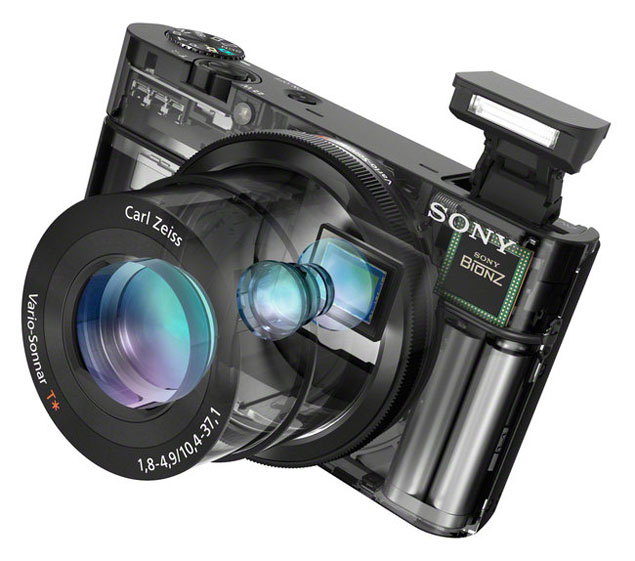
This is a review of the best pocket camera ever made. The Sony RX100 has a huge one-inch sensor - the biggest ever stuffed into a pocketable zoom camera
But first, a history lesson.
For years camera makers worried about competition from only one source: other camera makers. But in the end, the most dangerous predator came from an unexpected direction: cellphones.
Today, more photos are taken with phones than with point-and-shoot cameras. On photo sites like Flickr, the iPhone is the source of more photos than any real camera. No wonder sales of inexpensive pocket cameras are going down each year.
Cameras in phones are a delightful development for the masses. If you have your camera with you, you're more likely to take photos and more likely to capture amazing images.
But in a sense they are also great for camera makers, which are being forced to double down in areas where smartphones are useless: Zoom lenses. High resolution. Better photo quality. Flexibility and advanced features. That's why, even if sales of pocket cameras are down, sales of high-end cameras are up.
Now you know why the time is ripe for the new Sony Cyber-shot DSC-RX100. It's a tiny, pants-pocketable camera that will be available in late July for the nosebleed price of $650.
Or, rather, won't be available. It will be sold out everywhere. I'll skip to the punch line: No photos this good have ever come from a camera this small.
The first reason is easy to grasp. The Sony RX100 has a huge one-inch sensor - the biggest ever stuffed into a pocketable zoom camera. That's not as big as the sensors in S.L.R.'s and other lens-swappable cameras. But it's about four times the area of the previous pocket-camera photo-quality champs, like the Olympus XZ-1 and the S100. (The RX100's shiny black metal body looks exactly like them.)
A big sensor means big pixels, which gives you less grain in low light, better color depth and great dynamic range - the spectrum from darkest to lightest pixels.
A big sensor is also a prerequisite for that professional blurry background look. The RX100 easily achieves those soft backgrounds, a rarity in compact cameras.
The other star factor in the Sony is its Carl Zeiss lens, whose maximum aperture (lens opening) is f/1.8. That's the widest aperture you can buy on a pocket camera. That, too, helps explain its ability to blur the background, and its spectacular results in low light.
(As on any camera, that aperture shrinks as you zoom in. When you're fully zoomed on this camera, you're down to f/4.9. That's still better than the Canon's fully zoomed aperture - f/5.9.)
But you know what? All of that is just shutterbug-speak for, "This camera takes amazing photos." If you want to know what "huge sensor" and "big aperture" mean in the real world, stop reading and savor my annotated slide show of sample photos. There's a small sampling at nytimes.com/personaltech, and a larger one at http://j.mp/LdUu4h.
There you'll see what makes the RX100 such a revelation: insane amounts of detail and vivid, true colors. Hand-held twilight photos. A burst mode that can fire 10 frames a second. And macro shots - supercloseup - that will curl whatever's left of your hair. A typical S.L.R. can't get any closer than 10 inches from the subject with its included lens; the RX100 can nail focus only 2 inches away.
The RX100 is as customizable and manually controllable as an S.L.R., but it also has some impressive automated modes. They include Illustration (turns the photo into a colorful line drawing), High Dynamic Range Painting and the bizarre but sometimes enlightening Auto Crop. It creates a duplicate of your portrait, cropped in what it considers a better way. Sometimes, it's right.
And Sweep Panorama. You swing the camera around you in an arc, pressing the shutter button the whole time. When you stop, there, on your screen, is a finished, seamless, 220-degree panorama. It's the ultimate wide-angle lens. Canyons, crowd shots, Walmart interiors - you won't believe how often it's useful.
For self-portraits, you can set a timer as usual. Or use its even smarter mode, in which the camera waits until it sees your face in the frame. Then it fires a shot every three seconds until you leave the scene.
As usual on today's compacts, there's no eyepiece viewfinder, a loss you may mourn. But the three-inch screen remains clear and bright even in bright sunshine, thanks to an extra white pixel Sony has nestled in among every set of red, green and blue.
The 1080p video capture isn't quite the same festival of crispness as the photos. But you can use all the photo effects while filming. And while recording, you can zoom, change focus and even take still photos.
Sony has taken the debatable step of bringing back in-camera charging. That is, there's no external charger for the 330-shot battery. Instead, the camera is the charger, whenever it's connected to a USB jack, like the one on your laptop, or a wall outlet. Pros: No charger to pack and lose. Cons: You can't charge a spare battery while you're out shooting.
As with its role model, the Canon S100, you can program the function of the Sony lens ring. It can control zoom, focus, exposure, aperture, whatever. But unlike the Canon's ring, the Sony's ring doesn't click as you turn it - sounds that get picked up when you're capturing video.
On the hand, you don't feel clicks either. The ring spins freely, which gives it a glassy, skidding feeling when you're adjusting a setting with natural stopping points, like ISO (light sensitivity) or shutter speed.
That's not the only niggling downside. The biggest one, of course, is that there's very little room for physical buttons. All of the RX100's hundreds of functions are packed into five buttons on the back, a mode dial on top, the ring around the lens and a four-way clickable ring on the back.
Novices will find it overwhelming. Then again, it's fairly clear that this isn't a camera for novices. Besides, eventually it all makes sense. You learn to press the Fn button whenever you want to adjust a photographic setting, or the Menu button to adjust a camera-setup setting.
The camera has a 3.6X zoom lens. The Canon S100 zooms more (5X zoom). On the other hand, the Sony takes 20-megapixel photos, versus 12 on the Canon.
Ordinarily I'm not a fan of cramming more pixels into a camera as a marketing ploy. High-megapixel photos take longer to transfer, fill up your hard drive faster and are overkill for most printing purposes.
But on Sony's sensor, these are really useful pixels. You can crop away a huge part of the photo and still have lots of megapixels left for big prints; in effect, you're amplifying the zoom.
One last downside: In certain photos, when I adjusted the overall contrast in Photoshop later, I noticed some vignetting - darkened areas at the corners.
This is an ideal second camera for professionals. And it's a great primary camera for any amateur who wants to take professional-looking photos without having to carry a camera bag.
Of course, $650 is crazy expensive. You can buy a full-blown S.L.R. for that much.
But every time you transfer a batch of its pictures to your computer, you'll understand why you spent that money. You'll click through them, astonished at how often it's successful in stopping time, capturing the emotion of a scene, enshrining a memory or an expression you never want to forget. You'll appreciate that the RX100 has single-handedly smashed the rule that said, "You need a big camera for pro-quality photos."
And if you care at all about your photography, you'll thank Sony for giving the camera industry a good hard shove into the future.

All Resources Taken From NEWS
Softbank to buy eAccess for more than $1.8 billion

cellphone-big-295.jpg
Softbank Corp will acquire smaller rival eAccess Ltd in a $1.84 billion deal as Japan's No.3 mobile carrier steps up its battle for market share with its nearest competitor KDDI Corp.Softbank will pay 52,000 yen for every eAccess share under a share swap that will be completed in February, Softbank said in a statement on Monday, a premium of more than three times eAccess's closing price of 15,070 yen on Friday.
Softbank is setting the next stage of a market share war that intensified after KDDI broke Softbank's monopoly on Apple Inc's iPhone last year. Softbank, the first Japanese mobile service carrier to carry the popular smartphone, is vying with KDDI for iPhone devotees with the launch of the iPhone5 last month.
The addition of eAccess's subscribers would give Softbank a total of 39 million users, outstripping KDDI's 36 million customer base, Softbank founder Masayoshi Son said at a press briefing in Tokyo.
The generous premium was value for money because of the subscribers, increased network capacity and cost-saving that Softbank would gain, Son said.
"We are paying more than triple the current trading price of eAccess because the benefits come from the company's existing customer base. We do not think our shareholders will view this as a bad tie-up at all," Son told reporters.
Shares in eAccess jumped 26.1 percent to 19,000 yen on the Tokyo bourse on Monday, prompting a trading suspension. Softbank closed 1.8 percent lower at 3,105 yen.
The deal will be the sixth-largest merger involving a Japanese firm since the start of the business year on April 1, behind U.S.-based Micron Technology Inc's acquisition of bankrupt chipmaker Elpida Memory Inc.
Softbank is wooing existing subscribers with a trade-in deal on older models, while KDDI is seeking to draw new users with a tethering service allowing customers to connect to laptops and other devices via their iPhones.
Son also said he will launch a tethering service in December helped by eAccess.
Both Softbank and KDDI compete for subscribers with market leader NTT Docomo, which has 60.5 million users. It does not offer the iPhone.
All Resources Taken From NEWS

BSNL launches landline phones with video call facility

bsnllogo.jpg
State-run BSNL, in partnership with SIS Infosystems, launched telephones with video calling facility which will primarily be used to set up public Video Call Offices by replacing many of the PCOs."We will convert existing Public Call Offices (PCOs) to VCOs with these phones. People will be able to make voice calls to any phone and video calls to any other IP (internet based) phone," BSNL Chairman and Managing Director R K Upadhyay told reporters.
He said that most of the revenue of BSNL comes from landline phones and this new services is one of the initiative to increase company's revenue.
BSNL will charge Rs. 3 for 45 second video call made from VCO which will include 30 per cent commission for the franchise owner.
"There will be no need to use computers for making video calls for user of these video phones," Upadhyay said.
BSNL's Senior General Manager for Broadband, A K Jain said that around 770 PCOs have confirmed to shift their business to VCOs and the target is to have 10,000 VCOs set-up across the country.
The service was inaugurated by Advisor to Prime Minister Sam Pitroda who stressed on the use of video phones to reach rural masses.
"It will bridge the gap between urban and rural India. This will be a platform for growth as this network can be used for purposes like job interview, tele-medicine, tele-education and host of other services," Pitroda said.
BSNL will provide various categories of VCO franchisees based on the services that a franchisee owners wants to provide.
SIS officials said that people looking for franchisee will have to pay for VCO devices which starts from Rs. 25,000 and will have to sign an agreement for the business.
An official said VCOs having medical devices attached to it for remote diagnosis of a patient will also be made available. Many other services will be launched shortly for which prices will differ.
All Resources Taken From NEWS

Review: JBL ONBEAT

jblon.jpg
JBL has always had an affinity for unique high fidelity audio gear (remember Sound Sticks II) so be rest assured something interesting is in store for you. This time around we have wrapped our picky ears around the JBL ONBEAT, which is an ultra portable iPod/iPad Dock. High quality iPod/iPad docks are a rarity in themselves and finding one sub Rs 10,000 gets even harder, so the ONBEAT is a rare breed. So lets see if this one can appease our sonic sensibilities.
 
Design

Clearly, JBL intended to design something that would sit comfortably on your office desk or on your bedside table. For the most part,they succeed. The ONBEAT is a very well designed dock and it is relatively light, weighing only 1.9 pounds.

Even the speaker grill is made up of quality plastics, so we have been pampered with plush build quality as no other dock in this price range manages to look so premium.

At first glance its oval base and curvaceous structure lends it a look reminiscent of a croissant.There is also a heart shaped incision in the center which houses the iPod/iPad dock clamp. 

Besides this, we have the two 7.5 watt drivers on the sides. These are not dedicated drivers, they are designed to deliver all the frequencies through a singular unit. So, there are no dedicated tweeters and woofers.

The volume knobs are placed on the right hand side and they are made up of chrome like material,which lends a solid and comfortable feel to them.

On the rear end of the dock we have the standard power port, the ON/OFF switch, the auxiliary input, the USB port and a Video out. JBL has equipped the dock with all the connectivity frills a layman would need for his day-to-day entertainment.

The package even includes a remote control,the buttons of which are made up of a membrane like material.  All aspects of the dock can be easily accessed but,in the absence of a display, we sometimes did not realize what functionality we were activating. This was a tad problematic. So we would have appreciated a tiny display even if it bumped up the price.

Apart from this, an adapter for the docking station has been provided, enabling the iPod to be docked in landscape mode. This functionality is  meant for the iPod Touch and the iPhone but not for the iPad. Though one must mention that the iPad compatibility is a boon.
 
Sound Quality

At the outset we should make it clear that sky high expectations of the dock are unfeasible as the category of ultra-portable docks is itself limited by the general design of the products.

The ONBEAT is designed to do a specialized job and it serves its purpose more than adequately. Overall, the mid-range remains pretty balanced albeit a tad brittle, the treble response was on the brighter side of things but, as usual, the bass response was lacking.

All these qualities are par for the course and while testing the ONBEAT we found it sounded slightly better than the offerings shelled out by JBL's sister company Altec Lansing.However, it was definitely inferior to the similarly priced Logitech Rechargeable speaker dock S715i

For testing we picked some of our favorite MP3 tracks all encoded at 320KBPS. Interestingly, the results were quite varied.

We started with some electronic magnificence of Tangerine Dream's Poland and Firetongue. Generally, electronic music has an ambient overtone which always remains omnipresent coupled with a repetitive bass-line. We found out that the ONBEAT excelled at reproducing these sound gradations. The ONBEAT successfully managed to reproduce the elegant ambient nuances at low to-mid range volumes but the melletron and slap-back bass effects started to buckle at higher volumes.

We experienced similar results with the Guns n Roses' smash hit Sweet Child 'O Mine. The overdriven tone of Slash's guitar was not distinct enough as the ONBEAT failed to pick up the harmonic overtones produced by the higher notes at higher volumes and had a tendency to clip too.

While listening to some modern alternative rock in the vein of Nickelback's Rockstar we did not face many problems thanks to lower levels of distorted guitar in the mix. While the acoustic elements sounded decent they were notably brighter than usual. As far vocals went, Chad Kroeger's vocals remained crisp and the interlude with Billy Gibbons' spoken words sounded perfect. 

We also bravely tested some metal tracks such as Metallica's classic riff-montage called Four Horsemen and Megadeth's Hanger 18 but these sounded downright awful with the drivers buckling under the pressure exerted by the excessive distortion based tones.

Clearly these speakers are not designed to be pushed or to be used with more brash genres of music. They perform best when they are left alone on an office desk or the bedside for some ambient, lounge like music or simpler tracks, which do not overwhelm the drivers with multiple instruments.

 
Verdict

If you are looking for a decent dock for your office/bedroom, which also supports the iPad then the JBL ONBEAT, will fit the bill. But don't expect it bring the ceiling down. While it does not offer awe inspiring sound, it does manage to sound decent in popular genres of music which will be adequate for most. It even manages to offer good connectivity options which is another feather in its cap.

The only problem would be its steep price tag of Rs 9,990 as for slightly less we could get a similar sounding dock which would only lack the build quality of the ONBEAT.
 
Pros:
Solid Build Quality
Good Connectivity options
Portability
iPad compatible
 
Cons:
Brittle sound
Expensive
No display
 
Ratings:
Price: 2
Design: 4
Sound Quality: 3
Wow Factor: 3